Wedding Speech Order UK: Who Speaks and When
Somebody will tell you the best man goes last so you save the funny one for the end. That is not why. The order, the logic behind it, and what actually goes wrong.
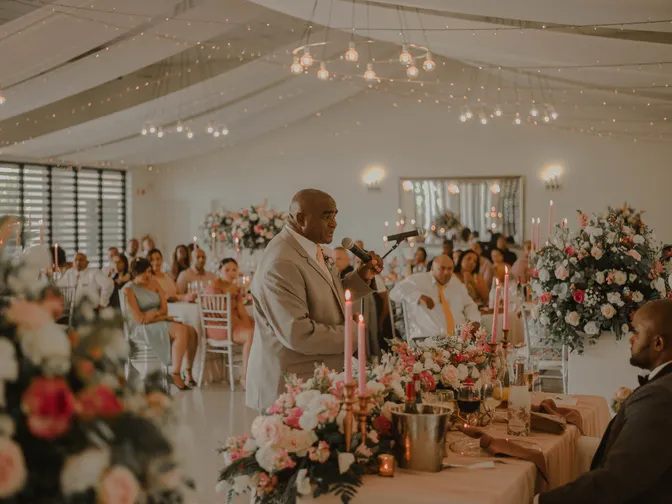
Somebody will tell you the best man goes last because you save the funny one until the end. That is not the reason. The traditional three speeches are a chain of replies, and the best man is at the back of it because he is answering a toast the groom made two speeches earlier. Once you know that, the order stops feeling arbitrary and starts feeling like something you are allowed to change.
The short version. Father of the bride, then the groom, then the best man. Traditionally they happen after the wedding breakfast, once dessert is cleared and glasses have been topped up, and the whole set runs twenty to thirty minutes. Anyone else you want to hear from goes before the best man. Doing the speeches before the food instead is now common, entirely fine, and the single change most couples say they were glad they made.
What is the traditional order of wedding speeches?
Three speakers, in this sequence, each one picking up where the last left off.
- The father of the bride welcomes everyone, thanks whoever needs thanking, says something about his daughter, welcomes the groom into the family, and toasts the couple.
- The groom replies. He thanks the father of the bride, thanks both sets of parents and the guests, says something about his wife, and toasts the bridesmaids. This is where "on behalf of my wife and I" comes from, and it is the line the room always cheers.
- The best man replies on behalf of the bridesmaids, since somebody has to answer that toast and it is not going to be the four year old with the basket. Then anecdotes about the groom, then any messages from people who could not come, then a final toast to the couple.
That is the structure Bridebook, Confetti and most UK venues will give you. Read it as a conversation and it makes more sense, because each speaker is answering the one before. The father speaks because he was, historically, the host who paid, which is also why he does the welcoming. The groom replies because he is the one being welcomed. The best man replies to the groom's toast because in a room where the bridesmaids were not expected to speak for themselves, someone had to. Every link in that chain assumes something about the wedding that is probably not true of yours.
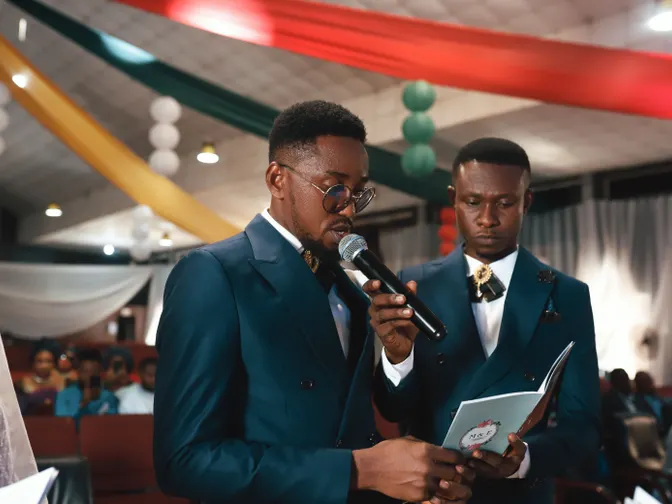
Who else can give a speech, and where do they go?
Anyone you like, and almost always before the best man. He is the natural closer because his toast hands the room over to the rest of the night, so slotting a new speaker in ahead of him costs you nothing structurally.
Brides speaking is the change that has actually happened. Bridebook's figures for 2024 put it at 28% of brides and 24% of maids of honour, which sounds low until you compare it with what people said they expected not that long ago. In a YouGov survey in August 2016, 62% of people thought the best man should speak, 51% the groom and 48% the father of the bride. For the bride, the figure was 16%, and it was no higher among women than men. A quarter of brides now speaking is a fairly sharp move for a decade.
If you want to speak, speak. If you do not want to speak and feel you ought to, do not. Some of the best versions we hear about are joint ones, where a couple do a single speech together and pass the microphone back and forth, which halves the nerves and gets a better laugh rate than either of them would manage alone. Mothers of the bride and groom, fathers of the groom, siblings and best friends all turn up in the running order now without anybody blinking.
The limit is arithmetic. Six speakers at seven minutes each is three quarters of an hour of sitting still, and the room's attention runs out well before the speakers do. Four is a comfortable maximum. If you have five people who genuinely deserve a turn, give some of them three minutes and say so when you ask.
Should speeches be before or after the meal?
Traditionally after, right at the end, once the dessert plates have gone and the staff have been round with the wine. That is still the default in most UK venues, and it is the version your caterer will assume unless somebody tells them otherwise.
We would nudge you towards doing them first, and the argument is not romantic. Anybody speaking has spent the ceremony, the drinks reception and three courses unable to enjoy any of it. Move the speeches to before the starter and they get their afternoon back at two o'clock instead of half past four. Your best man eats a hot dinner. Nobody has been drinking for five hours by the time they pick up a microphone, which improves speeches more than any amount of rehearsal.
The catch is that it has to be arranged well in advance. Kitchens plate up to a fixed clock, and a speech that overruns by fifteen minutes when the beef is already resting costs a hundred people a hot dinner. Tell the venue at the planning meeting, agree a hard finish time, and give the kitchen a signal for when to start service.
Speeches between courses is the compromise, and it works better than it sounds. One speaker after the starter, one after the main, one with dessert. The room stays awake, nobody is on their feet for forty minutes, and the meal stops feeling like the long bit in the middle. It does demand a venue that can hold plates, so ask before you promise it to anyone.
How long should wedding speeches be?
Five to seven minutes each, and under thirty minutes for the lot. Bridebook's per-role guide runs a little longer: seven to nine minutes for the father of the bride and no more than twelve, six to eight for the groom, around five for the best man, four to six for the maid of honour, three to five for the mother of the groom. Other planners put ten minutes a speaker as the outer limit and reckon most weddings land somewhere between twenty and forty five minutes in total.
The honest planning number is different from all of those, because everyone overruns. Whatever a speaker tells you, add a third. A best man who has promised you five minutes will do seven, partly because he will stop for laughs he did not plan for, and partly because he will read out a message from Auntie Pat that arrived the night before.
So do the sum backwards. Decide how long you want the whole block to be, divide by the number of speakers, tell each of them that number, and then budget for a third more when you write the day's timings. If the total lands past forty minutes, cut a speaker rather than trimming everyone, because the thing that makes speeches drag is their number and not their length.
The practical bits that go wrong
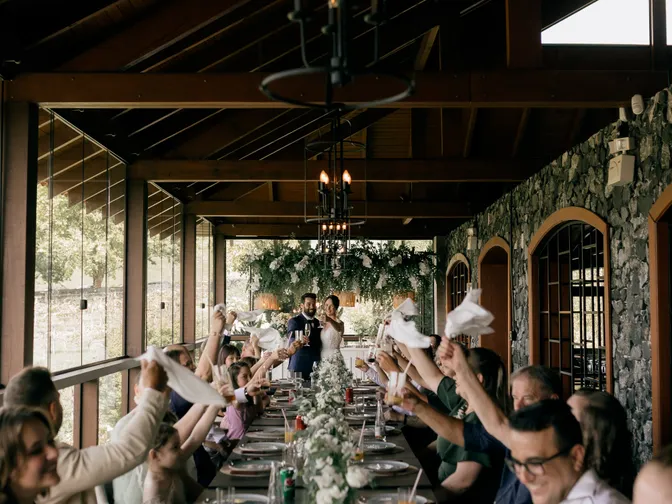
Almost everything that goes wrong with speeches is logistics, and it is the same short list every time.
Somebody has to introduce each speaker, and if nobody has been asked, the room does that awkward thing where three people half stand up. At most weddings it is the venue's duty manager or coordinator, so check they know the names and the order, phonetically if any of them are likely to be mangled. A professional toastmaster does this properly and costs roughly £250 to £600, with the average sitting around £500. Worth it at a big wedding in a room with poor sightlines, and hard to justify at sixty guests in a barn.
Glasses need to be charged before the first toast, not scrambled halfway through it, and someone should be told that soft drinks count. A toast where a third of the room is holding nothing is a flat moment on camera and slightly humiliating for whoever is proposing it.
Then the microphone. Test it in the actual room with the actual person holding it, because people who have never used one speak quietly into it and the back four tables hear nothing. If there is no microphone, say so in advance so speakers know they are projecting to the far wall. Tell your photographer when speeches are happening, and tell them who is speaking, or you will end up with eleven frames of the best man and none of your mum crying.
Last one, and it is the one people forget: notes on paper. Not a phone. Phones lock, dim, run out of battery and buzz with a message from someone who is in the room. Print the speech, put it in a jacket pocket the day before, and give a copy to somebody else.
Divorced parents, stepparents and the people you leave out
The traditional order assumes one father, one household and one person who paid for everything, and a good number of families are not shaped like that. There is no rule you are breaking here, only a set of feelings to manage, so make the decision early and tell people yourself rather than letting them work it out from the order of service.
Two arrangements do most of the work. Ask one parent from each side, which is even handed and lets you pick whichever of them will actually enjoy it. Or ask two people from the same family to speak back to back, briefly, which is easier than a joint speech if they are not on speaking terms. Stepparents who have been there for twenty years should be offered a turn, and it is better to offer and be turned down than to leave someone to notice they were not asked. The same conversation tends to arrive alongside who is paying for what, and for the same reason.
Same sex couples get an easier ride here, because there is no inherited script at all. Both partners speak, or one does, and the parents go wherever suits. It is the version of the day the rest of us are slowly catching up to.
If you decide someone is not speaking, give them a different job with a name attached to it. A reading in the ceremony, the welcome at the door, cutting the cake. People mind much less about not having a microphone than about not being counted.
Where the speeches sit in the day
A traditional afternoon runs the wedding breakfast from about three o'clock, speeches around quarter to five, and the room turnaround after that, which puts you comfortably clear of evening guests arriving at seven. Our wedding day timeline has the whole thing hour by hour, including why the gap after the ceremony needs two hours rather than the ninety minutes everyone plans.
Two timing details are worth checking against your own date. If your photographer wants couple portraits at golden hour and your speeches are scheduled straight through it, one of the two has to move, and in October that decision arrives sooner than you think. And if you are doing speeches before the meal, the drinks reception has to end on time, which is the part nobody enforces.
The running order will change four or five times between now and the week of the wedding, usually because a supplier confirms something that shifts everything after it. Keeping the timings, the speaker list and the supplier deadlines in one place you can both open is most of what our free wedding planner is for, and it saves the version in your head disagreeing with the version the venue has.
How to ask someone to give a speech
Ask early, in person or on the phone, and ask properly rather than dropping it into a group chat. Six months is plenty of notice. At six weeks you are asking a favour, and it is worth saying that out loud.
Give them four things when you ask: how long, roughly when in the day, who else is speaking, and anything that is off limits. That last one saves everybody. Nobody wants to hear about your ex, your stag weekend in Prague or how long it took you to propose, and a best man who has not been told will assume all three are fair game. Write it down in a message afterwards so there is a version they can check.
Then leave them alone. Asking for a draft is the fastest way to get a worse speech, because the person will write for your approval instead of for the room. The one exception is if you know they are struggling, in which case offering to read it is a kindness and they will usually say yes.
Get the order written down, share it with the venue, the speakers and whoever is running the music, and then stop thinking about it. We say the same thing about the order people walk down the aisle in, and the failure looks identical either way: everyone assumes somebody else has the list. You can set up a planner in a couple of minutes and put the speaker list in it tonight.
Speech questions couples ask us
What is the order of wedding speeches in the UK?
The traditional order is the father of the bride, then the groom, then the best man. It works as a chain of replies: the father welcomes everyone and toasts the couple, the groom replies and toasts the bridesmaids, and the best man replies on the bridesmaids' behalf before toasting the couple again. Any additional speakers, including the bride and the maid of honour, normally go before the best man so his toast still closes the set.
Who gives speeches at a wedding?
Traditionally the father of the bride, the groom and the best man. Modern weddings often add the bride, the maid of honour, the mother of the bride or groom, the father of the groom, or a sibling or close friend. Bridebook's figures for 2024 put bride speeches at 28% and maid of honour speeches at 24%. Four speakers is a comfortable maximum, because the room's attention runs out before the speakers do.
How long should wedding speeches be?
Five to seven minutes each, and under thirty minutes for the whole block. Bridebook suggests seven to nine minutes for the father of the bride, six to eight for the groom, around five for the best man, four to six for the maid of honour and three to five for the mother of the groom. Whatever a speaker promises you, budget for a third more, because almost everyone overruns.
Should wedding speeches be before or after the meal?
Traditionally after, once dessert has been cleared and glasses refilled, and that is still the default at most UK venues. Doing them before the starter is increasingly common and worth considering: nervous speakers get their afternoon back, everyone eats a hot dinner, and nobody has been drinking for five hours before picking up a microphone. It has to be agreed with the venue in advance, because kitchens plate up to a fixed clock.
Can the bride give a speech at her wedding?
Yes, and more do every year. A YouGov survey in August 2016 found only 16% of people thought the bride should speak, against 62% for the best man, but Bridebook's 2024 figures put 28% of brides speaking. Brides who want to speak usually go either first, setting the tone, or immediately before the best man. A joint speech with your partner is another option and tends to halve the nerves.
Who introduces the speeches at a wedding?
Usually the venue's duty manager or wedding coordinator, so check they have the names and the order in advance. A professional toastmaster does the job properly, announcing each speaker, warning guests a few minutes beforehand and making sure a microphone is to hand. Toastmasters cost roughly £250 to £600, with the average around £500, which is easier to justify at a large wedding than a small one.
What order do speeches go in for a same sex wedding?
There is no inherited order, which makes it simpler. Both partners can speak, or one, and parents from either side go wherever suits. A common shape is a parent from each family, then the couple together or in turn, then the best man, best woman or maid of honour to close. Pick the order that puts the most nervous speaker earliest.
Start your plan, free
Add your date and watch the countdown begin. The checklist, budget and guest list are waiting.
Create your free accountPhoto by Jay Jay Redelinghuys via Pexels. Additional images via Pexels.
← Back to The Planning Notes