Wedding Invitation Wording UK: Every Line, Explained
Nobody warns you that the first real piece of wedding admin arrives with Victorian rules attached. Whose name goes at the top, what each line is for, and what to leave off.
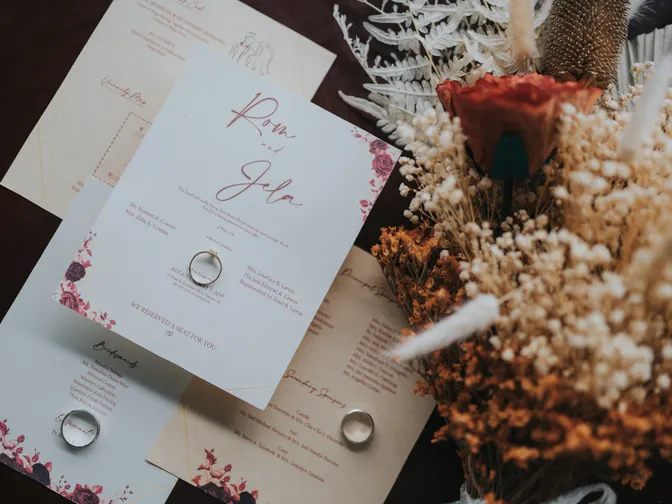
The invitation is the first bit of your wedding that anybody else holds in their hands, and it is the first bit of wedding admin with real rules attached. Not laws. Conventions, mostly Victorian, that a surprising number of your guests half remember. You find this out the moment you type "Mr and Mrs" into a template and realise you have no idea whose first name is supposed to come next.
The short version, before the detail. A wedding invitation carries six things: who is hosting, who is getting married, the date, the time, the place, and how to reply. Everything else (dress code, parking, the fact that you would rather have money than a toaster) goes on a separate card or your wedding website. Keep the invitation to those six and most of the etiquette problems disappear on their own.
What has to be on a wedding invitation?
Those six, in roughly that order down the page. The host line at the top, then the two of you, then when and where, then the reply instruction at the bottom. That shape has barely changed in a century and there is no prize for reinventing it.
What we would leave off: anything a guest cannot act on while holding the card. Gift requests, taxi numbers, the hashtag, a note about the field being muddy. All useful, none of it invitation material. Guests keep the invitation on the fridge for eight weeks and read the details card once, so the invitation should answer "am I invited, when, and where" at a glance from across a kitchen.
Whose name goes at the top?
Whoever is hosting, which traditionally meant whoever was paying. When the bride's parents host, the formal line runs "Mr and Mrs John Smith request the pleasure of your company at the marriage of their daughter Jessica to Mr Edward Jones". Note what that does to the bride's mother: she appears as her husband's first name. Plenty of couples still want that, and plenty look at it and quietly decide on "Mr and Mrs John and Sarah Smith" instead, which is now common enough that no stationer will blink.
If both sets of parents are contributing, both sets can head the invitation, bride's parents first by convention. If the two of you are paying, you host: "Jessica Smith and Edward Jones request the pleasure of your company at their marriage". And when the money has come from several directions at once, which is the normal arrangement now, the line that solves it is "Together with their families". It is warm, it is true, and it costs nobody any status. If working out your host line is going to need a family meeting, use that one and spend the energy on something that matters. Our guide to who pays for what covers the money conversation sitting underneath all of this.
Divorced parents get their own conventions. Name the mother first, drop the "Mr and Mrs", and if both are hosting, give them separate lines rather than one shared one. Remarried parents come as couples, one couple per line. A parent who has died can be named with "the late" before their name, or in a short line elsewhere on the card if you would rather not have it in the host position. There is no version of this that pleases everyone, so pick the version that pleases you and tell people before they see it printed.
Pleasure of your company, or honour of your presence?
A church, synagogue or temple takes "request the honour of your presence". A hotel, register office, barn or garden takes "request the pleasure of your company". The old reasoning is that a religious building is not yours to invite anyone into, so you are asking them to honour you by turning up rather than offering them a nice afternoon. Spell it "honour". This is a British invitation.
The detail worth more of your attention is the British habit of leaving a line for the guest's name. If you print "request the pleasure of the company of" followed by a dotted line, someone handwrites the names in. If you print "your company", the names go on the envelope or in the top corner instead. Either is correct. We push couples towards the dotted line for an unromantic reason: it forces you to write down exactly who is invited, by name, and that single act prevents most of the plus-one and children arguments before they start. A guest holding a card that says "Rachel Owen and Tom Price" does not wonder whether the kids are included. Our guide to the guest list goes further into who genuinely warrants a plus one.
How do you write the date, the time and the place?
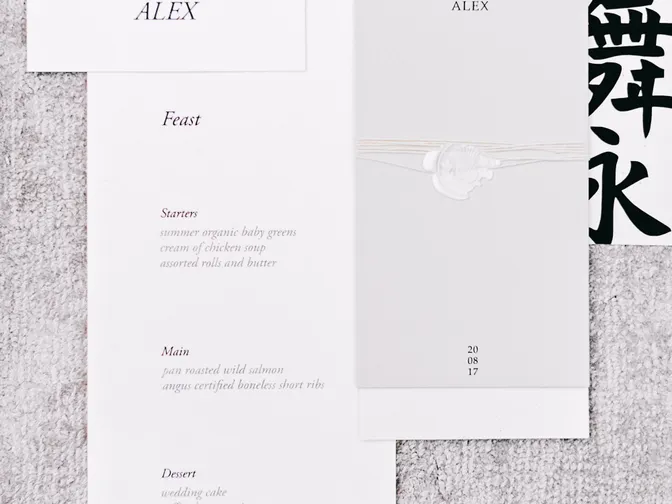
Formally, in words: "Saturday, the twenty-fifth of June, two thousand and twenty-six, at three o'clock in the afternoon". Informally, in numerals: "Saturday 25 June 2026 at 3pm". Both are fine. What looks wrong is mixing them, so if the date is written out in full then the time should be too. For the venue, give the full name and the town. A church usually needs no more than its name and village. Save the postcode for the details card, because that is the thing people will be typing into a phone at eight in the morning.
Now the bit almost every couple gets wrong, and it costs real minutes on the day. Print an arrival time, not the ceremony time. Guests treat the printed time as the time to walk in, which means a 3pm ceremony fills up at 3pm. Registrars in England and Wales have to interview you both beforehand and generally want you ready twenty to thirty minutes ahead of your slot, and they have another ceremony after yours. Print "2.30pm for a 3pm ceremony" and the problem goes away. While you are at it, tell whoever is running the processional the same two numbers.
At the other end of the day you can borrow the phrase "carriages at midnight", which is the traditional way of saying the party stops then. It sounds absurd and it is genuinely useful, because guests booking a taxi need a time. Put it at the bottom of the evening card or on the details card.
How do you invite someone to the evening only?
Print "Evening Invitation" across the top instead of "Wedding Invitation" and the awkward part is already done. Then say what is happening and when: "Please join us at an evening reception to celebrate our marriage, from 7.30pm at The Old Mill, Bakewell". Say whether there is food, because a hot buffet at nine and a bowl of crisps are different evenings and people will eat beforehand if you tell them to.
Two things not to do. Do not apologise, and do not explain the venue capacity. An evening invitation is an invitation, and treating it as a consolation prize is the thing that makes it feel like one. Send them at the same time as the day invitations, never later, because the gap is what people notice.
How do you say adults only without sounding cold?
Say what you want rather than what you are banning. "We are keeping our wedding day adults only" reads better than "no children", and both carry exactly the same information. Then reinforce it with the envelope: address it to the adults by name, and only the adults by name, because "The Wilson Family" undoes the sentence you just carefully wrote.
Say it on the save the date if you possibly can. Childcare needs booking and grandparents need asking, and a parent who finds out at the eight-week mark has a genuine problem rather than a hurt feeling. If you are making exceptions, say so plainly, whether that is babes in arms or the two children who are in the ceremony. An unexplained exception discovered on the day is the version that causes lasting damage.
How do you ask for money instead of gifts?
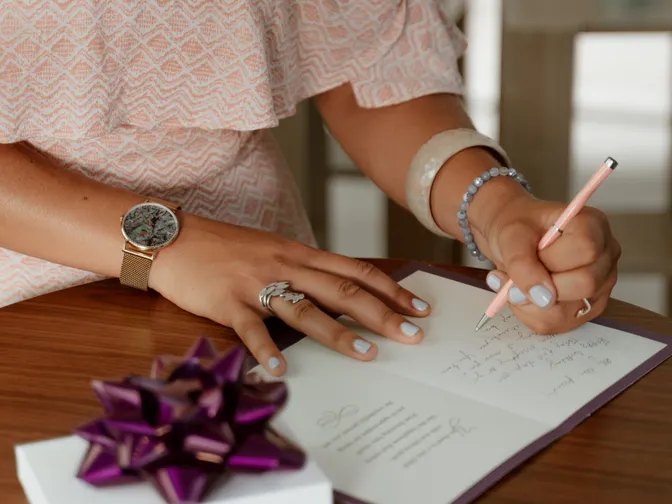
Not on the invitation. That is the whole rule, and it is the one couples break most often. Money goes on the gift insert or the wedding website, one step removed from the card that asks people to come. An invitation that mentions cash reads like an invoice, however kindly it is worded.
On the insert, name what the money is for. "A contribution to our honeymoon in Japan" or "towards the deposit on our first flat" lands completely differently from "cash gifts appreciated", because guests like buying a thing, even an abstract one. Wording that works: "Your company on the day is the only present we want. If you would like to give something, a contribution towards our honeymoon would mean a great deal to us." Then give the practical details, a link or a fund name, and stop.
One opinion, firmly held: no poems. The rhyming request for cash is the most reliably mocked object in British wedding stationery, and dressing the ask up in verse only draws more attention to it. Guests who were going to give you money were always going to give you money, and the ones who find the whole idea grabby will find a couplet about a wishing well grabbier still.
Dress code, dietary needs and the rest of the small print
Dress codes want two or three words, bottom right of the invitation or on the details card. "Black tie". "Lounge suits". "Garden party, flat shoes advisable". Anything longer starts to read as a set of instructions, and guests who need more detail will ask someone.
Dietary requirements belong on the RSVP, not the invitation, because that is where the guest is already writing their name. Give the RSVP a date rather than a request: "Please reply by 14 April". "As soon as possible" is not a deadline and will be treated accordingly. An online reply form is fine and increasingly normal, but print a phone number or postal address as well, because a proportion of your guest list is over seventy and will want to ring you.
Whatever route you choose, the replies then need to live somewhere other than a WhatsApp thread and your memory: who has answered, who is bringing a partner, who cannot eat shellfish, who is day and who is evening. That tracking is exactly what the guest list in our free wedding planner does, and a spreadsheet does it too. The part that matters is that one of you can open it and see the true number.
How many do you order, and what does the post cost?
One per household, not one per guest. For a hundred guests that is usually around fifty-five invitations, because couples and families share. Add roughly ten per cent as spares, plus one for your own box and one to hand the photographer on the morning, since reordering twelve invitations later costs far more per card than including them in the first run.
Budget between £1.50 and £6 per invitation for print on demand or semi-custom designs, less if you print at home, considerably more if you want letterpress or foil. Bridebook puts the UK average for a full stationery suite, save the dates through to thank you cards, at £378. Fully bespoke suites run into four figures.
Then the postage, which people forget entirely. A stiff invitation with an RSVP card and a details card tucked inside is a large letter, not a letter. Since 7 April 2026 a first class large letter is £3.30 and second class is £1.55. On fifty-five invitations that is £181.50 against £85.25, for a difference in delivery of a day or two. Send them second class and put the ninety-six pounds towards the bar. Take one finished invitation, stuffed and sealed, to a post office and have it weighed and measured before you buy a single stamp.
When should they go out?
Save the dates as soon as the venue is confirmed, usually somewhere between six and twelve months out. Invitations at around eight to ten weeks, with an RSVP date about four weeks before the day. If guests are flying, or the wedding is abroad, move the invitations out to three or four months so people can book flights while they are still affordable.
Sending earlier than that feels efficient and is not. People cannot commit to a Saturday five months away, so the replies arrive in a slow trickle and you chase the same twelve households twice. Our 12-month planning timeline puts this window in context with everything else that is due around the same point.
Read it out loud before you approve the proof
Print one, put it on the kitchen table, and read every line aloud to each other. Wrong years, missing postcodes and a bridesmaid's surname spelled two different ways all survive six rounds of screen proofing and die instantly on the first read aloud. Then check the reply deadline against your caterer's deadline, because those two dates disagreeing is the mistake that actually costs money.
After that it is a numbers job for eight weeks, which is the part we built the planner for. You can set yours up in a couple of minutes, put the guest list in it, and let it keep score while you get on with the rest.
Invitation questions couples ask us
What is the correct wording for a UK wedding invitation?
A traditional invitation names the hosts first, then the couple, the date, the time, the venue and the reply instruction. For example: 'Mr and Mrs John Smith request the pleasure of your company at the marriage of their daughter Jessica to Mr Edward Jones'. Use 'request the honour of your presence' for a religious ceremony and 'request the pleasure of your company' for a register office or licensed venue.
Whose names go at the top of a wedding invitation?
The hosts, which traditionally meant whoever was paying. That is often the bride's parents, but both sets of parents can host jointly, and couples paying for their own wedding can host it themselves. When several people are contributing, 'Together with their families' is the line that avoids ranking anyone. Divorced parents are named on separate lines, mother first, without 'Mr and Mrs'.
How do you politely ask for money instead of wedding gifts?
Keep it off the invitation itself and put it on a gift insert or your wedding website. Name what the money is for, such as a honeymoon or a house deposit, rather than asking for cash in the abstract. A line like 'your company on the day is the only present we want, but if you would like to give something, a contribution towards our honeymoon would mean a great deal' does the job. Skip the rhyming poem.
How do you say adults only on a wedding invitation?
State it positively, along the lines of 'we are keeping our wedding day adults only', and put it on the save the date as well so parents have time to arrange childcare. Address envelopes to the invited adults by name rather than to a family, since 'The Wilson Family' contradicts the request. Name any exceptions, such as babies or children in the ceremony, so nobody discovers them on the day.
How many wedding invitations do you need for 100 guests?
Around fifty-five, because invitations go to households rather than individuals. Order about ten per cent extra for mistakes and late additions, plus one for your keepsake box and one for the photographer. Adding a small reprint later costs much more per card than including spares in the original order.
How far in advance should wedding invitations be sent?
Eight to ten weeks before the wedding, with an RSVP deadline about four weeks before the day. Send save the dates far earlier, usually six to twelve months out, once the venue is confirmed. Push invitations out to three or four months if guests are travelling abroad or the wedding falls in a school holiday.
Start your plan, free
Add your date and watch the countdown begin. The checklist, budget and guest list are waiting.
Create your free accountPhoto by labill labill via Pexels. Additional images via Pexels.
← Back to The Planning Notes