Giving Notice of Marriage: When, Where and What It Costs
You can have the venue, the celebrant and a hundred guests and still not be married at the end of it. The 29-day rule, the £46.50 each, and the paperwork nobody warns you about.
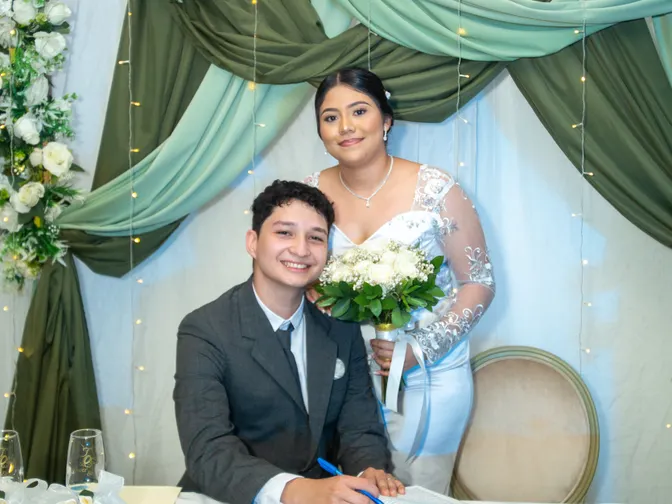
There is a version of your wedding day where everything goes beautifully and you are still not married at the end of it. Lovely venue, a celebrant you adore, a hundred happy guests, decent weather, and nobody having been to a register office a few months earlier to answer some questions about their passport. That appointment is called giving notice, and it is the only part of a wedding the law actually cares about.
The short version. In England and Wales you must both give notice of marriage at your local register office at least 29 days before the ceremony, in person, having lived in that registration district for the past 7 days. It costs £46.50 each. The notice is displayed publicly for 28 days, it stays valid for 12 months, and it only works for the venue you named on it. Church of England weddings usually replace this with banns instead. Scotland and Northern Ireland run on different rules entirely.
What is giving notice of marriage?
It is a legal declaration that you intend to marry each other, made to a registrar, on the record, in public. You go to the register office, a registrar asks each of you a set of questions separately about your name, age, address, nationality and marital status, checks your documents, and writes it all down. You sign it. Then the notice goes up on a board in the register office where anybody can read it for 28 days.
That public display is the whole point, and it is the oldest bit of the system. The waiting period exists so that if somebody has a legal reason why you two cannot marry, an undissolved first marriage being the classic, they get a window in which to say so. In practice nobody reads the board. But the 28 days are not negotiable, which is why the date in your diary and the date the registrar can act on are two different dates.
How far in advance do you have to give notice?
At least 29 days before the ceremony, and no more than 12 months before it. Those are the legal edges. The sensible window is a lot narrower than that, and here is why.
You cannot give notice until you have a confirmed venue and date, because the registrar writes the venue onto the notice and the notice only works for that building. So the earliest you can realistically go is once the venue contract is signed. At the other end, notice appointments themselves get booked up, and a busy urban register office in June is not going to fit you in next Tuesday. Aim for around three to six months before the wedding. Our 12-month planning timeline puts that in the same window as the invitations going to print, which is about right.
Leaving it to the 29-day line is the one genuinely dangerous piece of wedding admin, because there is no rescue. If a document is wrong or an appointment is not available in time, the wedding moves. Registrars cannot waive the waiting period out of sympathy, and every register office in the country has a story about a couple who cut it fine.
If either of you is not a British or Irish citizen and does not have settled status, pre-settled status, indefinite leave to remain or a marriage visa, the notice can be referred to the Home Office and the waiting period stretches to 70 days. The fee goes up to £63 each as well. That referral is routine rather than an accusation, but it needs real time in the calendar, so give notice early and expect the longer clock.
Where do you give notice, and do you both have to go?
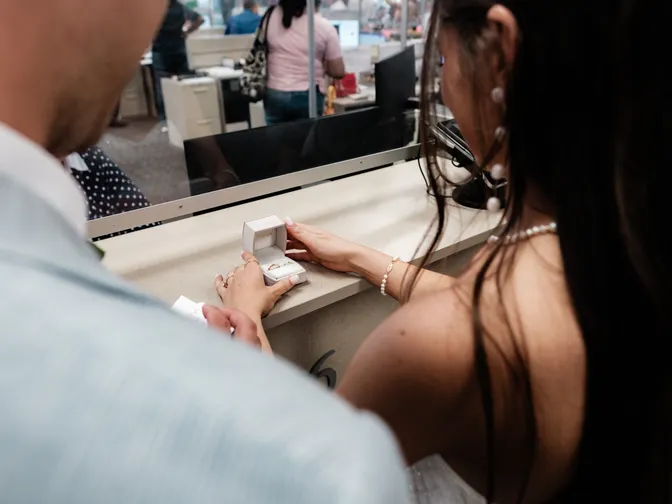
At the register office for the district where you live, not the district where you are getting married. Those are frequently not the same place, and it catches people out constantly. If you live in Leeds and you are marrying in a barn in North Yorkshire, you give notice in Leeds and the North Yorkshire registrar turns up on the day.
You must have lived in that district for the past 7 days before your appointment, which is only an issue if you have just moved. Both of you have to attend in person, and both of you have to pay, but if you live in different districts you go to your own register offices, and you do not have to do it on the same day. Nobody can do it on your behalf and there is no online version, because the interview is the whole point of the exercise.
What does giving notice cost?
£46.50 per person, so £93 for the two of you, and £63 per person if either notice needs a Home Office referral. Those figures rose on 6 April 2026 under the Registration of Births, Deaths, Marriages and Civil Partnerships (Fees) Regulations 2026, up from £42 and £57. They are set nationally, so a register office charging you something different for the notice itself has made a mistake.
The fee is normally payable when you book the appointment and it is normally non-refundable. One extra cost worth knowing about in advance: if either of you was divorced outside the UK, the Channel Islands or the Isle of Man, the paperwork has to be verified, which costs £55 if the register office can do it and £83 if it has to go to the General Register Office. That takes weeks, not days.
What do you need to take with you?
Originals, every time. A photograph of a document on your phone will not do, however good the photograph is, and neither will a photocopy. You need:
- A valid passport, or a UK birth certificate (register offices differ on when a birth certificate on its own is enough, so ring and ask before you rely on one)
- Proof of your address, such as a driving licence, a utility bill from the last three months, a bank statement from the last month or a council tax bill
- Proof of any change of name, a deed poll for instance, if your documents disagree with each other
- Your decree absolute or final order if you have been divorced, or your former spouse's death certificate if you are widowed
- The final details of the venue, which is why the venue has to be booked first
Check your own council's page before you go, because the acceptable list of address documents varies slightly and the appointment is wasted if you turn up with the wrong bill. This is one of those tasks that lives happily on a checklist rather than in your head, alongside the deposits and the supplier deadlines. Keeping all of it in one place is most of what our free wedding planner is for.
What happens if you change the venue after giving notice?
You give notice again, and you pay again. This is the detail that costs couples the most money and the fewest people know about it. The marriage schedule the registrar eventually issues is only valid for the building named on your notice, so moving the ceremony from one room to another inside the same approved premises is usually fine, while moving it to a different venue is a fresh £93 and a fresh 28-day wait.
Which gives you a simple rule. Do not give notice while you are still even slightly unsure about the venue, and do not give notice unusually early just to feel organised about it.
Do you need to give notice for a church wedding?
For a Church of England or Church in Wales wedding, usually not. The banns do the same job. Your names are read out in church on three Sundays during the three months before the wedding, in the parish where each of you lives and in the church where you are marrying if that is somewhere else. Banns stay valid for three months after the third reading, which is a much shorter shelf life than a civil notice, so they are read later than you might expect.
The Church of England's fees are set nationally too. From 1 January 2026 the marriage service is £566 and publication of banns is £39. If you both live in the parish where you are marrying, the statutory total is £605. If one of you lives elsewhere it is £664, and if you both do it is £723, because each extra parish means another £39 for reading the banns and £20 for the certificate proving they were read. None of that covers the organist, the bells, the flowers, the heating or a verger, all of which are priced by the parish and none of which are optional in the way you might hope.
Other religious weddings work differently again. Catholic churches, synagogues, mosques and temples in England and Wales normally need a civil notice as well, and then either the building has to be registered for marriages with an authorised person present, or a registrar has to attend. Be precise about this if you are having a nikah. An Islamic ceremony in a building that is not registered for marriage is not a legal marriage in England and Wales, and the House of Commons Library keeps a standing briefing on the subject because so many couples discover it at the point of separation or bereavement instead of at the wedding. Ask the venue whether it is registered, and ask before you book.
Registrar or celebrant: who can actually marry you?
Only a registrar or an authorised religious officiant can marry you in England and Wales. An independent celebrant cannot, and neither can a humanist celebrant, however good the ceremony is. This surprises couples every year because celebrant weddings look exactly like weddings, and because humanist marriages have been legal in Scotland and Northern Ireland for well over a decade.
So couples who want a celebrant do the legal part separately, usually a short register office appointment on a weekday with two witnesses, then the ceremony they actually want on the day. That is a completely normal arrangement now, and there is nothing awkward about it apart from deciding which date counts as your anniversary. Our guide to the processional covers the other half of a ceremony, the part with the walking.
This may be about to change. The Law Commission recommended rebuilding the law around the officiant rather than the building back in 2022, and on 16 July 2026 the Ministry of Justice launched a consultation called Tying the Knot, which closes on 24 September 2026. It asks whether humanist and independent officiants should be able to conduct legally binding weddings, and whether couples should be able to marry somewhere other than an approved building. Any actual change needs legislation and parliamentary time, so if you are marrying in the next two years, plan around the law as it is today.
What does the legal part cost on the day?
Giving notice only buys you permission to marry. The registrar's attendance is charged separately and set by each council, which is where the price stops being national and starts being a lottery.
The cheapest route is the short statutory ceremony at the register office itself, in the small room, on a weekday morning, with your two witnesses and nobody else. Depending on the council that runs from about £62 to around £160, and some councils include a certificate in that. Booking a registrar to attend an approved premises, meaning a hotel, barn or country house, is the expensive one: Cheshire West and Chester charges between £414 and £638 for 2026 to 2027 depending on the day and time, and Lancashire between £450 and £600. Saturdays and Sundays cost the most, which is the same story as everything else in the wedding budget. Then a copy of your marriage certificate is usually £12.50.
One booking note that matters more than the money. In most counties the registrar's diary fills before the venue's does, especially for summer Saturdays, and the registrar is the half of the booking that cannot be substituted. Ring the registration service before you commit to a date, not after.
What actually happens on the day?
The registrar interviews you both separately shortly before the ceremony, which is why your invitation should carry an arrival time rather than the ceremony time. Then the ceremony, then the signing.
Since 4 May 2021 there is no leather register to sign in England and Wales. The paper registers were closed and replaced with an electronic system, and what you sign now is a single A4 marriage schedule, together with your two witnesses and the person conducting the ceremony. The change brought one genuinely good thing with it: the entry has room for up to four parents' names each, so mothers and step-parents appear on it instead of only fathers, which was the rule for a hundred and eighty odd years.
Your witnesses need to be able to understand what is happening and to speak the language of the ceremony well enough to give an account of it. Most councils want them to be 16 or 18, so check yours. The registration service cannot supply them, which is the trap in a two-person elopement.
And you no longer walk out with a certificate. The schedule goes back to the register office, the marriage is entered into the national system, and the certificate arrives in the post afterwards, usually within a couple of weeks. If either of you is changing your name, that certificate is the document every bank and passport office will ask for, so order a spare copy while you are at it.
What about Scotland and Northern Ireland?
Different systems, and the differences are not cosmetic. In Scotland you both submit form M10 to the registrar of the district where the wedding is taking place rather than where you live, no earlier than three months and no later than 29 days before the date. You do not need to live in Scotland at all, which is why Gretna still works. And humanist celebrants can conduct legally binding marriages there, and have been able to for well over a decade.
In Northern Ireland you complete the GRO 446 marriage notice form and send it to the registrar for the district of the ceremony at least 28 days beforehand, up to a year ahead, and the registrar issues a marriage schedule once the 28 days have passed. Humanist marriages are legal there too.
If you live in one nation and are marrying in another, ring the registrar where the wedding will be and ask them, first, before you read another word on the internet. Ours included.
Do this bit in the right order
Venue and date confirmed. Registrar or officiant booked for that date. Then notice, three to six months out, with the right documents in one envelope. Then leave it alone, because it is the one part of the wedding that does not benefit from being revisited.
Everything after that is tracking: deposits, deadlines, replies, numbers. If you would rather it lived somewhere other than four group chats and a note on your phone, you can set up a planner in a couple of minutes and put the notice appointment in it as the first non-negotiable date.
Notice questions couples ask us
How far in advance do you have to give notice of marriage?
In England and Wales you must give notice at least 29 days before the ceremony, and no more than 12 months before it. You cannot give notice until the venue and date are confirmed, because the notice is only valid for the venue named on it. Most couples go three to six months before the wedding. If either of you is subject to immigration control, the waiting period can extend to 70 days.
How much does it cost to give notice of marriage?
£46.50 per person in England and Wales, so £93 for a couple, following the fee increase on 6 April 2026. It rises to £63 per person if either notice has to be referred to the Home Office. The fee is set nationally rather than by the council. Verifying a divorce granted outside the UK costs a further £55, or £83 if the General Register Office has to do it.
Where do you give notice of marriage?
At the register office for the district where you live, not the district where you are getting married. You must have lived in that district for the past 7 days. Both of you have to attend in person and both of you pay. If you live in different districts you each give notice at your own register office, and you do not have to do it on the same day.
What documents do you need to give notice of marriage?
Originals only: a valid passport (or a UK birth certificate in some cases), proof of your address such as a driving licence, recent utility bill, bank statement or council tax bill, proof of any change of name, and the final details of your ceremony venue. If you have been married before you also need your decree absolute or final order, or your former spouse's death certificate.
What happens if you change your wedding venue after giving notice?
You have to give notice again and pay again. The marriage schedule is only valid for the venue named on the notice, so a change of venue means fresh notices and a fresh 28-day waiting period. Moving between rooms inside the same approved premises is usually fine. Only give notice once the venue is genuinely settled.
Do you need to give notice for a Church of England wedding?
Usually not, because banns replace it. Your names are read out in church on three Sundays during the three months before the wedding, in each of your home parishes and in the church where you are marrying. Banns are valid for three months after the third reading. From 1 January 2026 the statutory fees are £566 for the marriage service and £39 for publication of banns, so £605 if you both live in the parish.
Can an independent or humanist celebrant legally marry you in England and Wales?
No. Only a registrar or an authorised religious officiant can conduct a legally binding marriage in England and Wales, so couples using a celebrant hold a separate register office appointment for the legal part. Humanist marriages are already legal in Scotland and Northern Ireland. The Ministry of Justice opened a consultation on reforming this on 16 July 2026, closing on 24 September 2026, but any change requires new legislation.
Start your plan, free
Add your date and watch the countdown begin. The checklist, budget and guest list are waiting.
Create your free accountPhoto by Marlon Averruz via Pexels. Additional images via Pexels.
← Back to The Planning Notes